


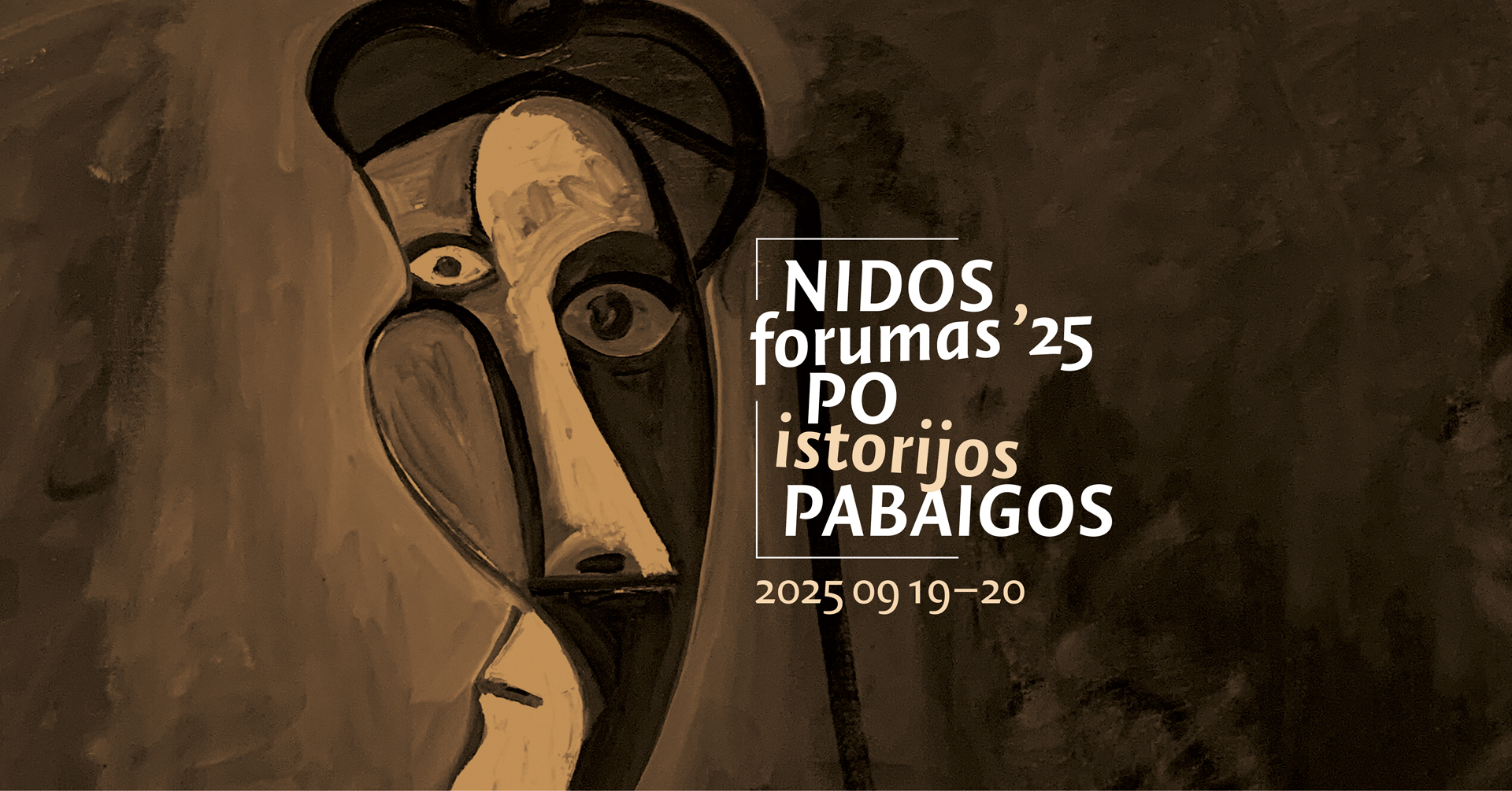
Nida Forum 2025
If you prick us, do we not bleed?
If you tickle us, do we not laugh?
If you poison us, do we not die?” –
as it goes in Shakespeare’s “The Merchant of Venice.”
When does something become unbearable? When it becomes too painful and repulsive to endure any longer? That is, this something didn’t just happen once – it has tested our endurance, physical and psychological, it hurt, tormented, disrupted normalcy, forced us to stand at attention, then clench into a fist, that something crossed all boundaries, manifested and engaged all reserves of our strength, and now has exhausted our capacity. Imagine, nothing remains: neither your house, nor your city, nor your former life. And so it is for millions of people all at once. Simultaneous erasure. All that a person and community can hope for in the unbearable is that it has an end and a limit. “Ne mozhe zh tak but’!/ This cannot be!” – as Tychyna, the poet, said with exclamation mark in Kyiv during Russian army massacre and plunder of Ukrainian capital back in 1919. Where there is suffering, there is also something that must stop it. The needle’s eye of death each time finds its red thread and strings along, strings along. We can experience ordinary, banal, statistical encounters with evil and wartime losses, but we also experience countless, previously undescribed ones. Not passed down from previous generations. We know too well here that cultural memory in our part of the world often stands for the archive – nonexistent, manipulated, destroyed.
Especially, when written records and those who fought for justice are systematically destroyed, cultural oral traditions become the crucial vessels of historical truth. The mothers, aunts and grandmothers who raise children carry these stories forward through generations, ensuring that suppressed histories survive in memory until they can eventually emerge into the full light of recognition and validation.
“There is no other Ukraine,” Taras Shevchenko wrote in 1845 in his poem addressed to the dead, the living, and the unborn countrymen when Ukraine was not to be found on the political maps of the time. Hence Ukrainians had no other choice but to fight for their homeland and to win. This is an epic, transformative story. Your homeland is under attack – you must defend it. Ukrainians are not wholly heroic by nature—we tried appeasement before with Peter the Great, we tried it later with Putin ceding Crimea and parts of the Donbas to imperial Russia in 2014 and 2015, hoping that compromise might bring peace. As we all know by now, it only invited further aggression. The lesson carved in blood and loss is this: when facing an empire that views your very existence as negotiable, survival itself becomes an act of resistance that cannot be halfway.
Living under Existential Threat
What existential threat exactly means as lived experience? You have not asked but I will tell you anyway: it is being grateful every morning simply to wake up together and discover that your friends and loved ones are still alive and almost unharmed, to approach each ordinary day as if it were your rebirthday. This is when only a thin line of defenders with Ukrainian insignia stands between you and occupation, between you and violence. It’s when every day, say, four hundred of them will be wounded, killed, or vanish without a trace. This is when your teenage daughter’s joy over a cooling bag for transporting donor blood—bought with pooled money to help medics on the front lines—exceeds any happiness you felt at her age receiving your first designer handbag.
The evolution from outrage to endurance. In the first weeks of the great war, it was a matter of courage, defiance, anarchic resistance. But in the fourth year of this war of attrition, it has become a question of patience and even willingness to suffer—because it’s better to suffer as equals among beloved strangers than to fall prey to an enemy who hates your very identity and the fact that you exist. “Beloved strangers” that beautiful paradox of kinship with unknown compatriots to whom you owe so much. Participatory work is key under given circumstances. Meaningful engagement is essential—it kindles hope and fosters connection. When people lose their power to act, they first retreat into self-absorption, then slide into bondage. Turning suffering into a show, a spectacle of pain is the worst.
There’s a spectrum of immersion in war. Only some of us have experienced war-as-war and trench-as-trench on our own skin. A much larger portion are those who have simply been working without days off for the fourth year now, going to sleep and waking up under air bombardments, having to cope with psychological and physical destruction, mourn the dead, withstand the cold and electricity outages and support the living with all their strength, run this marathon without stopping and rush to help others. Because when you’re walking through hell, they say, it’s better not to stop and keep going.
By 2022, Ukrainians had proven adept at social imagination, collaborative action, and civic engagement, building on accumulated knowledge and experience. We had come to grasp the full genocidal intent behind Russia’s war—a calculated revenge against our independence of thought and social solidarity, against our realized decentralization and inclusive commitment to the common good, against our insistence on human dignity above all else. This was punishment for reviving the anti-Soviet struggle for rights led by almost forgotten dissidents of the 1960s and 1970s, for making the value of human existence tangible and real. (And for doing this even when the Ukrainian economy was not growing but declining, or rising more slowly than wages and living standards in the neighboring tyranny). Ukrainians now understand, as few others can, that everything material vanishes in an instant—in the flash of a single strike. For the fifth generation in a row we are a culture without family heirlooms. But dignity remains our unbreakable core, the one thing that cannot be stolen from us or our children. In this chaos, our words in poetry must cut through the endless stream of social media images that flicker and fade in the white noise of information overload—they must endure where everything else dissolves.
Another dimension of this great war in Europe is Russian contempt for international law that has neither been brought to the dock nor met with immediate, forceful retaliation. The security architecture has proven worthless. As of mid-August 2025, whoever is stronger and more brazen is in the right. Ukrainian singularity is not so singular after all, and the privilege of remaining bomb-free could suddenly and accidentally end across our entire continent. This threat is taken seriously in the Baltic states.
Witness Literature and Narrative Justice
War breaks language and normalcy. Simply witnessing deliberately inflicted, repeated suffering—seeing it with one’s own eyes while acutely aware of one’s helplessness and vulnerability—can drive a person to moral paralysis. And this is where witness literature sprang up: that tension between the compulsion to speak and the paralysis of helplessness. The witness then is redefined as subject not object: the one who can speak, has credentials to speak and feels an obligation to speak up in testimony.
Elie Wiesel, in his Nobel acceptance speech, positioned witness literature as literature’s most significant innovation since the advent of modernism. Each era has contributed its forms—tragedy from the Greeks, epistles from the Romans, sonnets from the Renaissance—but our last hundred years have answered catastrophe with testimony. The specific literary form matters less than the fundamental shift: a new mimesis grounded in credibility, forging unprecedented trust between writer and reader through shared commitment to truth. Crucially, this literature often emerges from those previously excluded from literary canons—survivors, marginalized voices, those without traditional literary training—making it inherently aligned with decolonial efforts. It introduces the notion of narrative justice. Oftentimes, witness’ effort is situated in the fast-changing, risky, unsettling present. By privileging lived experience over formal education and centering voices that dominant cultures have systematically silenced, witness literature dismantles the hierarchies that have long determined whose stories matter and who gets to tell them. This democratization of literary authority transforms not just what contemporary literature can be, but who can create it, fundamentally challenging the gatekeeping mechanisms of traditional literary establishments.
Testimony presupposes a guarantor of what will be spoken. One always testifies before someone, and in this literary genre there is a demand for the authenticity of lived experience.This touches on what narratologists call the “testimonial pact”—a unique form of the autobiographical pact that Philippe Lejeune theorized, but with higher stakes. In testimony, the writer doesn’t just promise to tell their truth; they position themselves as a witness-narrator whose authority derives from presence and survival. As Shoshana Felman and Dori Laub argued in Testimony: Crises of Witnessing, this creates a triangulated relationship: the witness, the addressee (who becomes a co-witness), and the event itself. It is distinct from fictional or even autobiographical authority because it carries an ethical burden. Contemporary trauma theory (Cathy Caruth, Dominick LaCapra, Giorgio Agamben) emphasizes how testimony must represent the “unrepresentable,” creating what Agamben terms a “lacuna”—the gap where language fails but must continue.
In my Ukrainian context, this takes on additional urgency. The testimonial genre becomes what Gayatri Spivak might call a form of “strategic essentialism”—claiming the authority of experience precisely because that experience has been systematically erased or denied. The guarantor I mention isn’t just individual credibility but collective survival—each testimony validates others in a network of corroboration against deliberate disinformation.
Witness literature emerges from the unbearable—we rarely invoke this genre for nostalgic memoirs or documentary chronicles of peaceful times. The testimonial imperative arises precisely when harm exceeds ordinary narrative frameworks and demands a different kind of truth-telling. We turn to witness literature not to record life as it was lived, but to preserve what should never have happened and must never happen again.
The Sacred and the Sacrilegious: Russia’s Militarized Civic Religion
The Russo-Ukraine war has been often read out from geopolitical point of view. Ukrainians vs. Russians, anti-Soviets vs. pro-Soviets, pro-West vs. anti-West. There was less argument on the religious and cultural dimension of the war. USSR was an atheistic state from its inception that repressed and killed much of the clergy, plundered, and then destructed or repurposed majority of churches, synagogues, and mosques across the country by mid 1930s. Soviet policy aimed at eliminating religious practices in themselves. Executing this politics, it was vicious and blasphemous.
When the sacrilegious offence is verbal, it is called blasphemy, and when physical, it is often called desecration or just sacrilege. Blasphemy is word based, or image based. Sacrilege is blasphemy at work. There is understanding that ‘blasphemy, with its verbal, visual, and written assaults upon the sacred and identity, has reappeared to become a fixture upon the West’s cultural horizon’ (David Nash. Blasphemy in the Christian World: A History, OUP, 2007 p. 14). There is less awareness that it has become a fixture of Eastern Europe’s horizon as well. Then there is still less understanding that blasphemy operates as akin to post-truth:
Blasphemy pushes the limits of thinkable and sayable. When directed against the Spirit it is rendered in Scriptures as unforgivable. It is decoded as conscious and cynical resistance to truth. Resistance to truth and denying it make humility and repentance impossible. While this inability to repent blocks the very possibility of forgiveness.
Russia as a state and a church never shared responsibility and what is more never atoned for the past tragedies of the 20th c. On the contrary, it usurped and repackaged the memory of the great victory over Nazis under the slogan: We can repeat it! But what state propaganda implied was bringing back civilian tragedy and turning it into routine. Inflicting terror after terror, smashing schools, hospitals and residential areas while mocking the feebleness of international laws, values and security frameworks.
I’d like to argue that what has happened with the Russian mainstream Orthodoxy after 1991, or mostly after the turn of the millennium and Putin’s rise to power, amounts to malignant reformulation of the sacred, exploitation of the mythical image of the Holy Rus’ and then to the top-down sacrilege. The most influential study on the power of the Holy Rus’ metaphor in the last decades remains the book Sainte Russie by French historian Alain Besançon. He gave an adequate attention to the nexus of Russian Orthodoxy and Russian politics in the long durée, to Kremlin’s spiritual goals (not only its religious propaganda). Most importantly, in his view, this represents the blending of religious and national themes under the strict surveillance of a particularly despotic autocracy. No other country except the Holy Land has dared to call itself “holy,” yet the “Holy Rus'” utterance simultaneously surrounds the land, people, and state with a halo of sanctity.
Year after year the Moscow patriarchy was bolstering political image of Putin as main defender of Orthodoxy in the world. Patriarch Kirill was the one to excavate an ancient expression the Holy Rus’ and to modify it for the purposes of the 21st c. known under the name of Russkiy Mir /Russian World. He insisted that no ethnic differences and no political borders could shutter the alleged spiritual unity between Russians, Belarusians and Ukrainians. This ideological twist has been detected by dissident father Yakov Krotov as ‘imperial militarism’ of the Moscow Patriarchy.
This militant religious Russian nationalism was one of the key elements in Putin’s motivation for the invasion of Ukraine. When a church-led society acknowledges its own evilness without shame and even with pride, that’s when it crosses the line and slides into sacrilege. During Vladimir Putin’s two and a half decades in charge of Russia, the Soviet victory in the Great Patriotic War (as the World War II is still called there), has become the main building block of a new Russian civic religion. Since 2020, the war victory has its own religious shrine in Kubinka, and – when we look back from the year 2025 at the Putin era – this cathedral seems its most essential creation. The cathedral was the project of Russia’s then defense minister, Sergei Shoigu, and the opening was scheduled to mark the 75th anniversary of victory over the Nazis. Due to pandemic the ceremony was delayed and repurposed. Shoigu, Putin, and the Patriarch Kirill of Moscow attended the service, on 22 June, the anniversary of the Nazi attack on the Soviet Union in 1941. Patriarch Kirill, who has called Putin’s rule a “miracle of God,” said the new cathedral holds the hope that future generations will take up the spiritual inheritance from those before them and safeguard the Fatherland from all enemies, foreign and domestic.
Russia’s Cathedral of the Armed Forces is not an Orthodox church but a shrine to post-Soviet civil religion, featuring Soviet symbols in stained glass, military mosaics depicting battles, and floors made from melted Wehrmacht weapons. The controversial imagery blends militarism with Christianity—angels hover above artillery, the Virgin Mary poses like a Soviet war poster, and mosaics commemorate conflicts including “forcing peace on Georgia” and “the return of Crimea.” Originally featuring images of Putin and Stalin that were later removed after public outcry, the cathedral deliberately leaves space for future military conquests to be added to its walls—a deeply eschatological vision of endless war as sacred destiny.
The cathedral’s panels also commemorate Russia’s wars in Chechnya and Soviet military interventions that crushed the Hungarian revolution in 1956, the Prague Spring in 1968, and the invasion of Afghanistan—sanctifying these acts of aggression as sacred missions. While Russia has numerous war museums, this cathedral represents something entirely unprecedented: it makes explicit the quasi-religious framework through which war is remembered, glorified, and perpetually reenacted in Russian culture. It also makes blatantly clear the nexus between those who perpetrated violence and those who perpetuate it.
Breaking with History: Ukraine’s Counter-Narrative
To break with dark history, it is essential to be capable to imagine the history other way or just to imagine another future possible. Participation in culture has intensified and got deeper across Ukraine since 2014. The same could be said about participation in history. Institutions and societies, Ukrainians remind to the rest of the world, not only ‘preserve’ themselves but never stop changing. Not to be blinded by the readymade narratives is a responsibility of a decent free thinking.
The process of disintegration of the Warsaw Bloc and then the USSR itself fell into the era of postmodernism. Postmodernism was closely related to postcolonialism, and in the Soviet context it entered a culture heavily mutilated by socialist realism. Consequently, the marginal became central not only in novels and films, but it also found itself in the focus of political and economic news, as well as in the focus of historical news, called the closing of white spots, i.e. the disclosure of unknown facts, previously kept in the secret files and forbidden to the public. When the former colonies began to fight for their dignity, equality and independence, they spoke up. Their history and their truth were different from what was taught in the imperial capitals. Against this background, a new epistemological framework of pluralism and the coexistence of an infinite number of points of view and many micro-truths emerged. However, some “stories from below” and “stories from the periphery” turned out to be cognitively and morally incompatible with the official narrative of the post-empire. Its self-description crumbled and crumbled from the collision with the description made by the Other. Therefore, postmodernism gave a place for the Other, a platform, a screen and a microphone, but did not give it political power and moral weight, so that what was seen and experienced in a different way changed the consciousness of people raised by the empire, already after the empire.
The power of alternative histories was provided not only to work with collective memory, it was supposed to train the collective political imagination and prepare a different vision of an inclusive world and a different future. However, this vision has been obscured, and the future itself was blocked by the declaration of the end of history. The decentralization, eccentricity, and polyphony of postmodernism opened the sources for the emergence of some other common narrative – valid both in the former center and on the recent periphery: a narrative that is both more comprehensive and closer to the truth. The demand for truth returned and the episteme changed once more. The emancipatory potential of pluralism was exhausted because it led to irresponsibility, civic passivity, and criminal inaction. Now this was not a “let all flowers bloom” or “every version is right and wrong at the same time” instruction. After many decades of silencing and then fragmentation, dispersal of microhistories, there was an urgent need for a new synthesis, a new truth and even a new centralism. But on other principles.
There was the famous dispute between Kant and Lessing. Lessing argued that a lie which heals is always better than a truth which wounds. Kant maintained that while truth may sometimes hurt and lies may sometimes cure, one must always hold to the truth. Why? Because if we permit one great lie, then all agreements and declarations become suspect and lose their force, and communication between people becomes absurdly impossible. But his crowning argument was not pragmatic but ethical. Through lies we demean the dignity of another person, because we turn them into a means of achieving our own ends, however noble our intentions may be.
To understand the scale of distortions and threatening manipulations of collective imagination and memory in Russia prior and after the collapse of the USSR, it is necessary to look at the state of post-Soviet nostalgia through the optics of memory ethics. To see the inability of nostalgic people to distance themselves from the catastrophic past and place moral accents in it. This system was cruel and crooked. In Soviet cinema and literature, there were rare but still important attempts to circumvent or overcome censorship. Part of the cultural production worked with large audiences of viewers and readers, acting within the system, but using hints, the skills of “reading between the lines” due to secret biographical knowledge and the similarity of fate and experience.
Since the declaration of the Russian Federation as the legal successor of the USSR, glasnost has never been officially contested. But the works with the memory of, and especially with the guilt for, the Soviet systemic terror at the official level gradually collapsed. The grief and trauma of the victims and their descendants of the state violence inflicted by the USSR on its own citizens were not recognized and at least somehow compensated by the state, but were reduced to the circle of inconspicuous local groups of activists. Government programs for a detailed study of the mechanisms of mass repressions and artificial famine or legal prosecutions of the perpetrators of these historical crimes, if they were at the stage of development, did not gain strength. The formula that Stalinism with its millions of victims among the “enemies of the people”, as well as their women and children, and later Brezhnev’s persecution of dissidents and their families randomly affected all the peoples of the USSR, including the Russians, was presented as an insoluble ethical aporia: once everyone suffered, then there is no one to blame or no one to call to justice.
Determining the growth of Soviet nostalgia in Russia as a trend that deepened and grew in all generations, even the long-time opponent of the Soviet system, Mikhail Gefter, said in one of his later interviews that “The Soviet in general is something that has been lost and misplaced”. (Михаил Гефтер. Третього тысячелетия не будет. Русская история игры с человечеством. Москва: Європа, 2015. С. 5). None of the many researchers or commentators of this phenomenon dared to pose the question: “Is it moral to be nostalgic for the USSR?” or sharpen it to its core: “Is it conceivable to be nostalgic for the Gulag?”
These two questions are far from rhetorical; they undermine the picture of the world and the identity of the post-Soviet person. After all, based on this formulation of the question, thirty-five years after the collapse of the USSR, the Soviet past is no longer and cannot be the post-Soviet present. Its memory faded, and then it was retrospectively condemned in the Baltic countries, in Ukraine, Moldova and Georgia, in Kazakhstan, but not in the Russian Federation itself, which just happened to be the successor of the USSR. The Common Soviet (obshesovetskoye) ceased to be common. And now we know that not only nostalgia, but also solidarity in the lies about the Soviet legacy between the political elites, the mass media and the educated class has happened to Russians over these decades.
Zeitgeisty, post-Soviet men and women in Russia exchanged one nihilism for another.
The post-World War II emigration to the West during the Cold War transformed Russian and East Slavic studies, attracting top intellectuals to understand the Soviet Union across the Iron Curtain. By 1991, the twelve EU member states had produced thousands of specialists in the field, but these experts faced declining job opportunities as Russia-related research lost government funding and market demand after the Soviet collapse. However, this training created significant knowledge deficits and blind spots in their supposed expertise. Language instruction remained Russian-only, cross-disciplinary expertise stayed stubbornly Moscow-centric, and substantial teaching continued in what Ze’ev Jabotinsky called “Pushkin faith”—avoiding uncomfortable questions to preserve idealized narratives. In retrospect, given Russia’s barbaric war on Ukraine, such professional behavior constitutes intellectual dishonesty.
As older Sovietologists’ ranks thinned, few bright new East European experts emerged, perhaps because the attitudes, topics, and programs on offer had become obsolete. These outdated programs and research institutes sometimes received helpful funding from Russkiy mir (introduced in 2001 with Russian-orthodox and Slavophile tendencies) and oligarchic sources, allowing them to freeze in time rather than adapt to regional realities. Meanwhile, Ukraine was developing at astronomical speed—not economically, but in terms of its grassroots society, exemplifying healthy democracy.
This Russo-centrism contributed to Ukraine’s epistemic erasure as a unique socio-political and vibrant cultural space. This epistemic erasure must be understood in connection to the current material erasure through air bombs, missiles, and drone attacks. Even prestigious programs with long-term reputations promoted imperial messages explaining newly independent states as “belated nations” with “incomplete cultures” destined to remain in Russia’s sphere of domination.
Notably, the concept of Eurasian studies, institutionalized in the West over the last 20 years, was invented and disseminated by Putin’s notorious Valdai Discussion Club as part of his plan to create a Eurasian Union opposing the European Union. We Ukrainians have paid for this loud-mouthed ignorance with human lives, smashed livelihoods, and ruined communities. The books most helpful in detecting Putin’s assault on civil society and looming war came from field studies of contemporary Russia and Ukraine but not from the Russian studies.
Just as the birth of deconstruction took place adjacent to the construction of the Berlin Wall—although few recognized this at the time—it appears that a new optics and ethos of the humanities are now emerging.
The European West since 1989 has been a utopian place with no enemy. It feared the Soviet Union for so long – and for a reason – that it opted for immediate amnesia after the Berlin Wall collapsed, and the Soviet army left Central Europe removing its nuclear peril. The Soviet Union peaceful dissolution made it a post-Wall, post-Soviet but, above all, post-Cold war area. Ukraine’s nuclear disarmament was a happy hiatus. Nobody in the West was afraid anymore and almost nobody was paying attention to what comes after. But in Russia’s eye the enemy was there, and the devil was still coming from the West.
The Grammar of Survival: Between Fracture and Continuity
There are experiences and gestures that a writer’s imagination could never invent. Do you know why modern Ukrainians in big cities, when going to bed, put dog food in one pocket of their pajamas and flower seeds in the other?
The first, so that search and rescue dogs can sniff them out faster if they’re still alive but unconscious under the rubble—the quicker they can locate a person in distress, the better the chances of clearing the ruins in time to save someone. The second, in case they don’t manage to survive. Then a person wants to leave at least some trace at the site of their murder in this unpunished terror—let their favorite flowers sprout and bloom there.
Do you know why migrating storks fight among themselves when returning to their Ukrainian villages in the war zone? No, not because people fight on the front lines and set a bad example for them to follow, but because part of last year’s houses were destroyed along with their nests, and there aren’t enough nesting spots for everyone—new ones must be created. And storks do indeed weave new nests in the old places, inventively using new makeshift materials of war, for example, fiber optic cables that hang everywhere like giant spider webs endlessly woven by flying drone-spiders. Actually, storks have been flying here every March for millennia as totemic animals that people love and protect, and whom they watch with longing as they fly away in formations to North Africa six months later, having raised their chicks from small eggs into large and strong birds. So yes, storks return even during war, for the 11th year now.
You will discover exactly how well you are protected when you test your protection. In recent years, storks have seen how non-flying humans abandon their half-destroyed nests and become defenseless displaced persons.
Good and evil, for me, involve particular names and circumstances—my own included. Ethics emerges where autobiography meets history, shaped by the storyteller’s own nature. When Hamlet reference “to be or not to be” is no longer your choice but lies in the aggressor’s hands, the vulnerability of helplessness becomes a devastating trap. Rather than succumb to this paralysis, Ukrainians often chose a paradoxical strategy: to remain fragile yet forge an unbreakable resilience.
And where is the role of the writer and literature in this? It lies in the great and the small. It seems to me that for a writer from a country that has been defending itself from an aggressor for years now in a war of attrition and survival, there are several tasks.
How do we tell the story of contemporary Ukraine so that it penetrates Europe’s minds and souls hundreds and thousands of miles away? How do we distill unarticulated feelings? How do we translate daily nightmares? Or the vibrant life which goes on? How doesn’t everybody live in bunkers and underground. War is the setting of the story, but it is not the whole story. How people live, love, cope, and produce kindness and care for each other—this is the story.
There’s also another level of task, even more demanding. The focus on massive crime, anger and seeking narrative justice. Writers should write about how to bring about at least some justice, how to restore and rehabilitate victims’ dignity, body and soul. And how to move forward. We lose friends and loved ones almost daily, in their beds or on daily chores strolling through their cities, there’s no secure place anywhere in Ukraine for the fourth year, we are in the debilitating non-stop process of mourning. Is joy stolen forever?
And lest we forget that Ukrainian army effectively deterring Russian aggression along the 1000 km long front line is people’s army. It is comprised of ordinary citizens of all walks of life of all ages like you and me. And many of my fellow writers told themselves on the bad morning of February 2022: “I will write more poetry and prose, but I am fighting this war first.” This full-scale war has already claimed over 250 souls from our cultural world—artists, singers, writers, critics, translators—each loss irreplaceable. Davyd Chichkan, 39, carried four generations of artistic legacy in his blood: son of a Kyiv artist, grandson of an artist, great-grandson of a revolutionary painter in Ukraine’s 1920s avant-garde. He chose the battlefield over the studio and gave his life for our defense on August 10. So, this is also a story of the people having to chose between creating and defending the very culture they help build.
And the enemy fears not only our brains and weapons, but also our simple humanity. It destroys points of warmth, rescue, mutual aid. That’s why, besides housing, so many hospitals and medical stations have been destroyed, schools and universities, humanitarian volunteer centers, libraries and resilience centers—all those third places where people can gather and serve as support for one another. But Ukraine is strong in horizontal connections and thanks to European backing we do not stop going through hell. Every life is priceless, every feat is priceless, and we maintain the courage to save. We have real heroes now, we don’t need to invent them or pretend—their deeds are real and life-saving for us—and for you.
My grandfather told me when I was still little that intelligence, decency, and great trials should not be written on a person’s forehead but your effort paves the way.
The key difference between what happens to Ukrainians under Russian occupation and what happens to them when they are free but randomly die under daily air attacks, under cruise missiles, bombs and shaheds from Russia, is this: here everyone must realize their own mortality and say goodnight each time as if it were the last, without excessive pathos, but in a way that shows all their care and love; there, in the occupied territories, everyone must realize their own humiliation and lacking protection of the law—you will be raped, tortured, separated from your family, stripped of agency, home and property, and only then will you die. The choice is clear: either it is free Ukraine, all of it, or this is another concentration camp and genocide in the middle of Europe.
“Protect the protectors”—that’s the lesson here. This slogan must become the defining political and cultural imperative of our century, because this is not simply Russia’s war against Ukraine—this is war against all rules, an avalanche of horrific war crimes. When deterrence and penalty fail, survival itself dictates the terms: protect the protectors, destroy the destroyers.
Join the sovereignty of European states to regain strength and relevance.
Let us remember, the strength to endure in inhuman conditions is not limitless. And it’s better for the European community to move even faster, because “This cannot be!” In all the hot spots of the planet, we must protect life saturated with love and unity, the lifestyle of nurturing, local rootedness in communities, non-orphanhood.
More than once it has happened that within our Ukrainian PEN trips to unbreakable libraries in frontline zones with new books, necessary humanitarian aid and literary meetings-readings, we asked ourselves: who charges whom more? So much light, hope, human warmth, food, stories and quiet care we received from those who are truly exhausted and tired from the war and its ever-growing threats and losses.
Our friends from the Kharkiv Literary Museum called their new exhibition and performance around it “In the Name of the City.” (Let me remind you that under pressure from Russian forces, two-million Kharkiv emptied by two-thirds, to maybe just 800 000, but held out, neighbors became like family to each other, and now people are returning, youth is returning and the city lives its resurrection and transformation). The exhibition is about dear Kharkiv as a city in a bulletproof vest, a city under the protection and care of its own residents. It is hieroglyphically simple, like a visual 3D telegram to the future, carved by skilled hands from a piece of wood. Here is an apartment building. Here’s another and another. Here’s a map of the city between two rivers, like the Tigris and Euphrates and their Mesopotamia. Here are death masks, many deaths. Here’s a flower and a tree, a person and a book, and a bird. And the black hole will not swallow them, never, because they have already become symbols. And here is the rough thick thread that binds everything firmly together, and if one of them falls, the others will fall too, and if after falling they need to straighten up, they all have to do it in turn, carefully, in one rope team, like mountain climbers. And victory—Peremoha—will also be one for all, though many will not live to see it. I know that I sound here unashamedly sentimental, but this is how it feels in medias res.
My country now is like a teenager whom you can ask: who do you want to be? Because it’s growing and developing so rapidly, and it definitely won’t be the same as before this war. What my foreign colleagues from various countries sometimes envy me for is our wonderful youth, our students, already so mature, wise, responsible, seasoned idealists among the experienced. Let me tell you a story from Savyntsi, a large village whose community was under occupation for six months in 2022. Many material losses, many fellow villagers killed—essentially every twentieth person—there were also stories of collaboration and denunciations. But who has now become the core of the community, who strategizes, as they say, a community without outskirts, where no one is left unaccounted for and not at the center of attention? That same wonderful youth. They have 110 project ideas for how to arrange their new better life, and more than twenty are being implemented right now, not after, but during the war. We need a world in which global institutions indorse these new sensitivities, think and act in the right magnitude and at the high speed. Where we stretch our imagination against parochial thinking. Another era for democratic Europe will begin.
And to my question whether they understood that, following Savyntsi’s example, their generation would gradually have to rebuild almost all of Ukraine as part of the new Europe? And it will take decades of work? The answer was simply: Yes. And that’s wonderful. Because we won’t rebuild it brick by brick as everything was, but with love and consideration, with respect for what came before—we’ll rebuild our country as we want it, as we need it for the future’. I couldn’t help but grin—happily. To borrow from my fellow Lvivian Stanisław Jerzy Lec—black humorist, witness, survivor—let’s not expect too much of the end of the world.
Now let me close, as poets do, with a poem.
And in the heart, unsubdued by evil.– Ivan Svitlychny
A letter to speak out, not to say something.
A non-creation of non-art, collective, not mine.
Many, many days spent in energy-saving mode.
Our advantage was once considered vitalism—life-affirmation.
There was so much passion around, such vibrant colors.
And now, like in a hospice, nothing is unfading.
Every day they come for someone.
Sensors have atrophied, it’s hard to feel anything,
except anger or rage.
It’s hard to understand what’s unclear here.
If cows could write, they would also write
about care and guardianship,
about how important it is to be milked carefully and on time.
Caregivers live, like people of war, in circular time,
where there’s no end in sight.
No novelty indeed; we’ve seen it all before,
we’ve gotten used to everything, layer by layer.
No progress, everything is exactly as it was for our grandmothers.
Again and again, without vacation or rest,
without normal sleep, without a comprehensible goal.
Every person needs someone caring, loving,
especially at the beginning and at the end.
Attention is such a rare and generous gift.
Daily care without exaltation, without elevation.
Hello, we survived the night, we lived to see the morning.
Feed with warmth, wash with fragrance, wipe dry,
listen to the same funny story for the five hundredth time and smile wearily
to understand that you can no longer handle this but handle it somehow.
Take into account the given conditions,
not the ideal ones, as in a school problem.
Care and nursing are blood, piss, shit, and a bowl of vomit.
Even under bombs, especially under bombs,
the crucial question remains the same:
‘How much of someone’s pain and decline are we able to alleviate?’
This is part of the cause-and-effect human connection.
Like a heat-seeking missile launched from MANPADS,
a letter belongs more to the addressee than to the author.